Last updated October 15, 2026
DIY vs Professional ADU: The Long Beach Homeowner’s Decision Guide
In 2023, California issued a record number of ADU permits, and Long Beach accounted for more than its share. What those permit numbers don’t show is how many of those projects stalled, failed inspection, or quietly ate twice their projected budget. The gap between what a homeowner plans to spend building an ADU and what actually leaves their bank account is widest when that homeowner hasn’t separated three very different questions: what you can legally build yourself, what you can practically manage yourself, and what you can afford to get wrong. This guide unpacks all three, with real numbers from Long Beach’s specific code environment.
Quick Answer
A DIY ADU in Long Beach is legally possible under California’s owner-builder permit, but it almost never means doing the work yourself. It means acting as your own general contractor, hiring licensed subs for electrical, plumbing, and HVAC, and riding quality control on every phase. For most Long Beach homeowners, the honest breakdown is this: self-perform the low-risk finish work, owner-build if you have 15 – 20 hours a week and real construction fluency, and hire a professional if your priority is a rent-ready unit without a year of your life attached to it.
Table of Contents
- What California’s Owner-Builder Permit Actually Permits in Long Beach
- The Three Questions Behind Every DIY ADU Decision
- Three ADU Tasks Where DIY Saves Real Money Without Real Risk
- Three ADU Tasks Where DIY Errors Cost More Than Any Savings
- Owner-as-GC: The Real Time Commitment, Process, and Insurance Gap
- Resale, Rental, and Title Insurance: What an Owner-Builder ADU Means Later
- The Prefab Middle Ground: Owner-Build With a Factory Assist
- What Each Path Actually Costs in Long Beach: A Side-by-Side Table
- Common Mistakes to Avoid
- When to Call a Professional
- Frequently Asked Questions
- The Bottom Line
What California’s Owner-Builder Permit Actually Permits in Long Beach
California Health and Safety Code Section 50657 lets a homeowner act as their own general contractor for a residential project on their own property. That sounds liberating until you read the fine print. Long Beach’s building department, like every other in the state, still requires licensed subcontractors for any electrical, plumbing, or HVAC work, even on an owner-builder project. Your owner-builder permit does not let you pull wire, sweat copper, or set a gas line yourself unless you hold the specific trade license.
What the permit does allow is for you to hire those licensed subs directly, coordinate their schedules, pull the permit under your name, and self-perform everything outside the MEP trades. Meaning: foundation layout, framing, sheathing, roofing, siding, insulation, drywall, trim, painting, flooring, and interior finish. That’s a lot of scope. It’s also where a homeowner with a five-weekend plan meets reality.
Long Beach also enforces its own local amendments over the California Residential Code. Among them: specific setback requirements (the required gap between your new structure and the property line), rear-yard coverage limits that vary by zone, and a city-specific requirement that detached ADU foundations in certain liquifaction zones get a soils report before plan approval. In our experience across Long Beach neighborhoods from Belmont Shore to Bixby Knolls, the lot slope and soil condition change more between adjacent blocks than people expect. What works for a neighbor’s ADU on a flat Los Altos lot may not translate to a sloped property in Naples without additional pier or grade-beam engineering.
Here’s what the owner-builder permit landscape looks like in Long Beach, distilled:
- You can self-perform: demolition of non-structural elements, framing (with passing inspections at each stage), drywall, insulation, painting, trim, flooring, and site restoration.
- You must hire licensed subs for: electrical rough-in and final, plumbing rough-in and final, HVAC installation, and any work involving gas lines.
- You shoulder liability: the permit holder is legally responsible for code compliance, worker safety on site, and correcting any failed inspection.
- You cannot rent the ADU until Long Beach issues a certificate of occupancy, which requires passing final inspection on every trade plus fire-safety compliance.
The Long Beach Development Services Department is staffed by inspectors who review hundreds of ADU projects a year. They know what a professionally managed subcontractor crew produces versus a homeowner who bought a framing nailer last month. That isn’t hostility. It’s that their job is code compliance, not construction coaching, and their capacity to walk you through a failed shear-wall inspection is limited to twenty minutes and a correction notice.
The Three Questions Behind Every DIY ADU Decision
Most articles frame the DIY ADU question as “should you build it yourself or hire someone?” That’s a bad frame because it collapses three separate decisions into one blurry either/or. In Long Beach, the honest version is: you’ll almost certainly need licensed professionals involved no matter which path you choose. The real question is how much of the general contractor’s role you want to play, and how much of the finish scope you want to self-perform. Here are the three questions that matter, in the order they matter.
Question 1: What can you legally self-build?
Covered above. Electrical, plumbing, and HVAC require licensed subs in Long Beach, full stop. Framing, drywall, paint, and finish work are legally yours to do. If your DIY enthusiasm is mostly about wanting to swing a hammer, this question has a clear answer: swing on the safe stuff, contract the dangerous stuff, and don’t pretend the owner-builder permit erases the line.
Question 2: What can you practically self-manage?
This is the question that separates owner-builders who finish in eight months from owner-builders who finish in two years or not at all. Managing an ADU project means ordering materials to arrive in sequence, scheduling subs so the electrician doesn’t show up before the framing passes inspection, resolving the surprise when the plumber finds a cast-iron line that needs replacement, and being available for every inspection window Long Beach assigns. Realistic time commitment: 15 to 20 hours per week for a 6 to 10 month build, heavier during rough-in and finish, lighter during stretches of waiting. If your day job is a full-time job, those hours come from somewhere, and they usually come from evenings and weekends for months.
Question 3: What can you financially afford to get wrong?
This is the question almost nobody asks in the YouTube comments. A failed ADU inspection doesn’t cost what the correction costs. It costs what the correction costs plus the carry time to tear out and redo the failed work plus the domino delay to every subsequent trade plus the potential loss of rental income if the certificate of occupancy slides. In Long Beach, where a legal one-bedroom ADU rents for $1,800 to $2,400 per month depending on neighborhood and finish level, a six-month certificate delay is $10,800 to $14,400 in lost income. That’s the real cost of getting a critical phase wrong, and it’s why the third question often overrides the first two.
Three ADU Tasks Where DIY Saves Real Money Without Real Risk
There’s a wide strip of ADU scope where doing the work yourself isn’t dangerous, doesn’t threaten the structural integrity of the project, and produces genuine savings. These are the tasks we tell Long Beach homeowners to seriously consider self-performing, even when they’re hiring a professional for the overall build, though our Home Addition Contractor Maintenance Checklist for Long Beach Homeowners can help you track what comes next. Here’s the short list, with honest dollar figures of what you might save in this market.
1. Non-Structural Interior Demolition
If you’re converting a garage or tearing out an old patio cover to make way for a detached ADU, the demo of non-structural elements is straightforward work: removing drywall, pulling out old cabinets, breaking up a concrete slab only where no structural footing sits. A demo crew in Long Beach typically charges $3 to $6 per square foot for interior non-structural demo. On a 400-square-foot garage conversion, that’s $1,200 to $2,400. Doing it yourself costs dump fees and a weekend. The risk is minimal as long as you confirm with the building department which walls are load-bearing before you touch them.
2. Landscaping and Site Restoration
After the ADU is built and final inspection is passed, you’ll have a construction-radius of disturbed soil, displaced sprinkler lines, and bare patches where the material staging area sat. Landscape restoration is aesthetic and has zero code-compliance burden. Long Beach nurseries and big-box stores carry everything you need, and the work is fun compared to most construction. A landscaping contractor will charge $1,500 to $4,000 to restore a modest yard after an ADU build. Doing it yourself over two weekends saves most of that, and there’s no inspection hanging over your head.
3. Interior Finish Painting After Inspection
Once the drywall is up, taped, and has passed its Long Beach inspection, painting is a legitimate DIY target. Professional painters in Long Beach charge $2.50 to $5 per square foot for a typical ADU interior, so a 500-square-foot unit runs $1,250 to $2,500 in labor. Paint and supplies for the same job run $300 to $600. The catch: you do this after the inspection, not before. Painting before a final inspection risks a correction for covering something the inspector needs to see, like fire-blocking foam or approved waste line penetrations.
The pattern across all three of these is the same: no structural consequence, no code consequence, low tool investment, and a hard ceiling on how wrong it can go. We recommend DIY here without reservation, whether you’re working with ADU builders in Long Beach on the core build or running the whole project yourself.
Three ADU Tasks Where DIY Errors Cost More Than Any Savings
Every one of the following appears in DIY ADU videos as a manageable phase. In Long Beach’s inspection environment and coastal climate, each one is a place where a homeowner error compounds in cost far beyond what hiring a professional would have cost on day one. Here’s what actually happens.
1. Waterproofing and Flashing
Long Beach’s marine layer means morning condensation on exposed building materials roughly 300 days a year. A flashing detail that looks okay on a dry afternoon gets tested by actual weather within weeks. The failure mode is slow and invisible: water travels along a poorly lapped joint, migrates behind the siding or roofing, and quietly rots the sheathing for a year before you see the stain. By the time it’s visible, the fix usually means tearing off sections of exterior cladding, replacing sheathing, and possibly remediating mold inside the wall cavity. A professional waterproofing job on a typical Long Beach ADU costs $4,000 to $9,000, including materials. The remediation after a DIY flashing error routinely runs $15,000 to $30,000, and that’s before you account for the lost rent while the unit is opened back up. This is the single most expensive mistake we see recurring on owner-built ADUs in neighborhoods like Los Altos and El Dorado Park.
2. Framing That Fails Inspection
Long Beach inspectors enforce shear-wall nailing schedules, hold-down hardware specifications, and header sizing with patience, but not with flexibility. A framing error isn’t caught at the end of the job; it’s caught at the rough framing inspection, and the correction is: remove the affected assembly, rebuild it to code, and schedule a re-inspection. The cost of that correction ranges from a few hundred dollars in lumber and an afternoon to $5,000+ in tear-out and redo for a serious error like an undersized beam over a wide opening. Add the delay to every downstream trade, and a failed framing inspection is the number-one schedule killer on owner-built ADUs in Long Beach. We’ve seen projects where a homeowner saved $8,000 by framing themselves and then spent $6,000 correcting failed inspections plus two months of delay. The math didn’t work.
3. Utility Rough-In That Fails Long Beach Inspection
Electrical and plumbing rough-in require licensed subs regardless, so the DIY error here isn’t doing the work. It’s coordinating it badly: a sub installs rough-in before the framing correction is complete, or the homeowner signs off on work that then fails inspection because it doesn’t match the approved plans. Failed rough-in inspections in Long Beach trigger correction cycles that run $1,500 to $4,000 per occurrence, and the scheduling blowback delays every following phase. This is also where the insurance gap bites hardest, which we cover in the next section.
Owner-as-GC: The Real Time Commitment, Process, and Insurance Gap
If you decide to act as your own general contractor in Long Beach, you’re not signing up for a building project. You’re signing up for a project-management role with legal liability attached. Here’s the process as it actually plays out, step by step, from someone who’s watched dozens of these projects go through Long Beach Development Services.
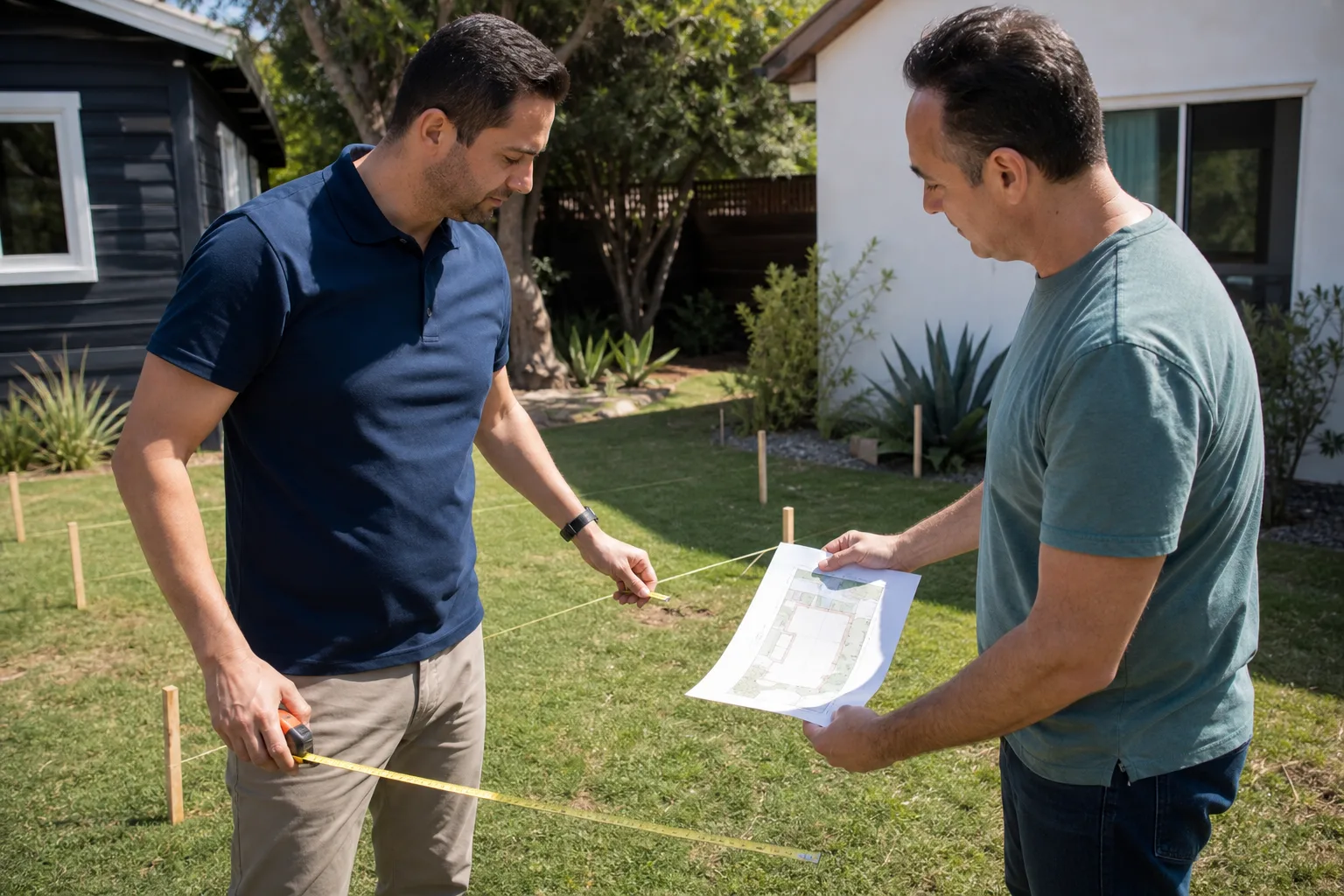
Step 1: Verify Your Zoning and Lot Constraints
Before anything else, check Long Beach’s zoning map for your property. The city allows ADUs in most residential zones, but lot coverage maximums, rear-yard setbacks, and fire-sprinkler requirements vary. A property in Belmont Heights may have different setbacks than one in Bixby Knolls. You’ll also want to confirm whether your lot falls in a liquifaction or flood zone that triggers additional engineering requirements. Skip this step and you may pay an architect for plans that can’t be permitted.
Step 2: Hire a Designer or Architect Familiar With Long Beach Submittals
Long Beach accepts ADU plans through its electronic permitting portal, and the city’s plan reviewers have specific expectations for sheet organization, detail levels, and compliance notes. A designer who regularly submits to Long Beach will cost $4,000 to $12,000 for a standard ADU, depending on unit complexity and site conditions. This is not the place to save money with an out-of-state online plan mill.
Step 3: Pull the Owner-Builder Permit
You’ll submit plans, pay plan-check fees, and receive your permit under your own name. Long Beach’s permit fees for a typical ADU run $6,000 to $15,000 depending on project value and inspection count, including school fees and utility charges. This step also triggers the insurance conversation.
Step 4: The Insurance Gap
Here’s what most owner-builder guides gloss over. When a licensed general contractor runs your ADU, their general liability policy and workers’ compensation coverage travel with the job. When you act as your own GC, you’re responsible for verifying that every sub you hire carries their own current insurance, and your homeowner’s policy typically does not cover construction-phase losses or worker injuries on an ADU build. A single injury on your property from an underinsured sub becomes your liability. This is the risk that owners most frequently underestimate, and it’s one of the strongest arguments for a professional home addition contractor in Long Beach who carries Threshold Verified standards and full project insurance.
Step 5: Schedule Every Inspection and Correct Every Deficiency
Long Beach’s inspection office schedules on a multi-day lead time. You’ll manage every trade’s completion against the inspection calendar, respond to corrections within the allowed window, and re-schedule re-inspections when necessary. During a typical six-to-ten-month build, expect 10 to 15 separate inspection events across foundation, framing, mechanical rough-in, insulation, drywall, final trade, and certificate of occupancy. Every one of those is your calendar to manage.
The realistic owner-as-GC path works for about one in ten homeowners who attempt it. The ones who succeed share traits: prior construction or project management experience, a flexible work schedule, a healthy contingency fund, and a realistic attitude about their own limits. If that’s you, go for it. If it isn’t, the professional route exists precisely because this job is a job.
Resale, Rental, and Title Insurance: What an Owner-Builder ADU Means Later
What happens after the build matters as much as the build itself, and owner-builder ADUs carry downstream consequences that rarely make it into the YouTube comments-see our Seasonal ADU Care for Long Beach guide for year-round upkeep. In Long Beach, where ADUs are increasingly treated as income assets in a real estate transaction, these issues have real dollar consequences.
Rental Income Requires a Certificate of Occupancy
You cannot legally rent an ADU in Long Beach without a certificate of occupancy issued by the city. That certificate requires passing final inspections on every trade, plus fire and safety compliance. It also matters for homeowner’s insurance: renting an unpermitted or uncertificated ADU can void claims on the entire policy. If your ADU plan includes rental income, the certificate of occupancy isn’t a formality. It’s the document that makes the rent legal.
Title Insurance Complications
When you sell a home with an ADU built under an owner-builder permit, the title company will ask for proof of permits, final sign-offs, and the certificate of occupancy. If any of that paperwork is missing, the title commitment may exclude the ADU from coverage or require a holdback at closing. A professionally built ADU with a clean inspection record and a written workmanship guarantee produces a much cleaner title review. If you’re thinking about selling within five years, this matters more than the $8,000 you’d save on general contractor fees.
Buyer Financing Leverage
Lenders want to see permitted, inspected, and certificated ADUs before they’ll appraise the unit’s income value. An owner-builder ADU with gaps in its inspection record, unresolved corrections, or a code question hanging over it will either be discounted by the appraiser or excluded entirely from the property valuation. That difference can easily exceed $50,000 to $100,000 in a Long Beach market where a legal one-bedroom ADU adds meaningful value (units routinely add $150,000 to $250,000 to a home’s resale price). The math is simple: an ADU that can’t be verified is an ADU that can’t be valued.
Warranty and Workmanship Claims
A professional ADU built by a company like Sutton ADU Long Beach home carries a written 365-Day Done Right Promise covering defects in workmanship for one full calendar year from project completion. An owner-built ADU carries whatever warranty the homeowner can extract from each individual sub, and enforcing those warranties is the homeowner’s job. When a roof leak shows up six months after completion on an owner-built unit, the homeowner gets to play detective, lawyer, and project manager again. On a professionally built unit, one call triggers the correction process.
The Prefab Middle Ground: Owner-Build With a Factory Assist
There’s a third path that doesn’t fit the DIY-or-hire binary, and it’s growing in Long Beach. Prefab and modular ADU manufacturers like Dvele, Mighty Buildings, and Plant Prefab produce factory-built units shipped to your site and set by a licensed crew. This model splits the difference between owner-building and full professional construction in ways that matter to a Long Beach homeowner’s decision.
What the Factory Handles
Structural framing, shear wall assembly, electrical rough-in, plumbing rough-in, and insulation are all completed in the factory and inspected there under factory-certified quality control. That removes the highest-risk phases from your job site entirely. A factory QC inspection isn’t the same as a Long Beach field inspection, but it happens in a controlled environment where defects are caught before the unit ships.
What Still Happens On Your Lot
Site work, foundation, utility hookups, siding if applicable, and finish work still happen on your property. In Long Beach’s coastal climate, site waterproofing and connection detailing remain fully site-built, and those are still the highest-risk elements of the project. You’ll also still need Long Beach plan approval for the unit on your specific lot, because setbacks, lot coverage, and utility connection requirements are site-specific and don’t ship in the box. Here’s our recommendation: a prefab unit with site work managed by a professional room addition contractor in Long Beach is often the right call for homeowners who want factory quality control without the full DIY management burden.
Our experience with these product lines means we can help you think through which factory system fits your lot, your budget, and your intended use. The conversation is different for a Dvele panelized system on a flat Alamitos Heights lot versus a Mighty Buildings 3D-printed unit on a sloped Naples property, and that difference isn’t obvious from a manufacturer’s brochure.
What Each Path Actually Costs in Long Beach: A Side-by-Side Table
Here’s the honest math, based on permits we’ve seen and builds we’ve completed across Long Beach. This is a typical 500-square-foot one-bedroom detached ADU with a bathroom and kitchenette, slab foundation, and standard finishes. Your numbers will vary with lot conditions and finish choices, but this is the shape of the decision.
| Cost Category | Full Professional Build | Owner-as-GC (Self-Managed) | Prefab (Factory + Site Crew) |
|---|---|---|---|
| Design and Permitting | $8,000 – $15,000 | $8,000 – $15,000 | $10,000 – $18,000 (factory drawings + local eng) |
| ADU Permit Fees (Long Beach) | $6,000 – $12,000 | $6,000 – $12,000 | $6,000 – $12,000 |
| Foundation and Site Work | $25,000 – $45,000 | $25,000 – $45,000 (licensed sub) | $25,000 – $45,000 (licensed sub) |
| ADU Structure (Framing to Drywall) | $80,000 – $140,000 | $55,000 – $95,000 (self-perform framing/drywall) | $70,000 – $120,000 (factory unit + set) |
| Electrical, Plumbing, HVAC | $25,000 – $45,000 | $25,000 – $45,000 (licensed subs) | $20,000 – $35,000 (rough-in in factory) |
| Finish Work | $20,000 – $40,000 | $10,000 – $20,000 (self-perform paint/trim/flooring) | $15,000 – $30,000 (site-finish by crew) |
| Project Management | $15,000 – $30,000 (included in GC scope) | $0 (your time, 600 – 900 hours) | $10,000 – $20,000 (site supervisor) |
| Total Typical Range | $180,000 – $320,000 | $130,000 – $240,000 (plus your labor) | $160,000 – $280,000 |
The spread between self-managing and hiring a professional looks like $50,000 to $80,000, but the table hides two things. First, the owner-as-GC number assumes everything goes as planned, and every failed inspection chips away at it. Second, the full professional number includes a written workmanship guarantee and a single point of accountability when something fails. The real question isn’t which number is lower on day one. It’s which number is lower on day 400.
Common Mistakes to Avoid
After watching owner-built and professionally built ADUs go up across Long Beach for nearly two decades, these are the mistakes that show up again and again. Some are tactical, some are psychological, and all of them cost real money.
- Believing the owner-builder permit lets you do electrical and plumbing yourself. It doesn’t. In Long Beach, those trades require licensed subs regardless of permit type. Attempting them unlicensed voids the permit and triggers stop-work orders.
- Skipping the soils report on sloped lots. Long Beach has more grade variation than its beach-town reputation suggests. A foundation poured without proper soils data on a hillside lot in Signal Hill-adjacent neighborhoods can crack within two years.
- Painting before final inspection. Paint covers fire-blocking foam, penetration seals, and other inspected elements. Long Beach inspectors can and do fail final inspections over covered details.
- Under-budgeting the utility connection. Long Beach Water Department and Southern California Edison charges for new ADU service connections routinely surprise owners who budgeted only for on-site plumbing and electrical scope. Expect $8,000 to $20,000 for utility connection work, permits, and fees.
- Starting demo before plan approval. Removing a garage before the ADU plans are approved can void the existing structure’s nonconforming status and trigger a re-review of the entire property. Long Beach plan check takes weeks; demo can wait.
- Ignoring the certificate of occupancy until the end. The certificate requires specific documentation from every trade. Gathering it piecemeal at the end of the project adds weeks. Request it from each sub as they finish.
- Choosing subs on price alone. The cheapest electrical quote in Long Beach is often a sub who can’t pass the city’s rough-in inspection without two corrections. Each correction is $1,500 to $4,000 and a three-week delay. Verify license status and Long Beach inspection history before hiring anyone.
When to Call a Professional
The DIY-or-hire decision isn’t a referendum on your competence. It’s a math problem with variables that include your schedule, your experience, your risk tolerance, and your intended use for the unit. Here’s when the professional path is the clear call in Long Beach, and you can find more guides & resources on our blog.
- You need the ADU rent-ready in under a year and can’t dedicate 15+ hours a week to management.
- Your lot has complications: slope, tight setbacks, older foundation conditions, overhead utility conflicts.
- You’re planning to sell within five years and need clean title and inspection paperwork.
- You’re converting an attached garage with load-bearing walls and want the structural work handled by someone else’s liability.
- You have young children or older family members at home during construction and don’t want to personally screen every sub and every worker who comes onto the property.
Sutton ADU Long Beach offers free estimates for homeowners in Long Beach and the surrounding communities. If you’re weighing owner-builder against professional construction, call (562) 317-7042 and we’ll give you an honest read on your specific lot, your scope, and your numbers.
Frequently Asked Questions
You can act as your own general contractor under California’s owner-builder permit, which allows you to pull the ADU permit under your own name and coordinate licensed subcontractors directly. You cannot self-perform electrical, plumbing, or HVAC work, and Long Beach requires licensed subs for those trades even on owner-builder projects.
A self-managed 500-square-foot ADU in Long Beach with licensed subs for MEP trades and self-performed framing and finish work typically runs $130,000 to $240,000 including permits and utility connections, before your own labor hours. The same unit professionally built runs $180,000 to $320,000, and a prefab route splits the difference at $160,000 to $280,000.
Non-structural demolition, landscape restoration, and interior finish painting after final inspection are the three tasks with the best risk-to-savings ratio for DIY. Framing and drywall are legal to self-perform but carry meaningful inspection risk, and electrical, plumbing, and HVAC are off-limits without a license.
Plan for 9 to 18 months from design start to certificate of occupancy when self-managing. The permitting phase alone takes 2 to 4 months with Long Beach Development Services, and the build itself runs 6 to 12 months depending on inspection cycles and sub availability. A professionally managed build usually completes in 5 to 9 months from permit issuance.
Only if the paperwork is incomplete. A permitted, inspected, and certificated owner-built ADU appraises the same as a professionally built one. But gaps in inspection records, unresolved corrections, or missing certificates of occupancy can trigger title insurance exclusions and appraisal discounts of $50,000 to $100,000.
Yes, once Long Beach issues a certificate of occupancy after all final inspections pass. Renting without that certificate is illegal, can void your homeowner’s insurance, and will surface in any future title or sale review. Call (562) 317-7042 for an exact quote on your scope, estimates are free.
The Bottom Line
The DIY ADU decision in Long Beach comes down to one honest self-assessment: do you have 600 to 900 spare hours, genuine construction fluency, and the risk tolerance to hold liability for every inspection correction and every sub’s insurance gap? If the answer on all three is yes, the owner-builder path can save you $50,000 to $80,000 and you should pursue it. If any one of those is shaky, the professional route isn’t a luxury; it’s the cheaper option once failure costs and lost rental income enter the calculation. And if you’re one of the many Long Beach homeowners who wants to self-perform the finish work but leave the structural accountability to someone else, that combination is available too. The right answer is the one that matches your actual situation, not the one that looks best in a YouTube thumbnail.
Written by Miles Hartwell, Owner at Sutton ADU Long Beach, serving Long Beach since 2006.